PROGRAM
AN UNFORGETTABLE WEEK
Summer Port offers a full week of hands-on courses, exciting activities, and time on the water. Whether you’re building skills, trying something new, or making friends, there’s something for everyone.
COURSES & CLASSES
Build Your Skills
Summer Port offers a variety of courses and classes designed to help you grow as a Sea Scout. From seamanship and navigation to leadership and specialized skills, there’s a class for every interest and experience level.
BSC 101 - Boating Safety
Course Overview
Covers boating safety education based on National Association of State Boating Law Administrators (NASBLA) standards, including essential knowledge for safe recreational boating.
Advancement Opportunities
Ordinary: 15.a
Level 1 Elective: America’s Boating Club L1
Instructors
Louis McBridge, Bruce Rodgers, Michael McBride
ELS 101 - Electric Systems
Course Overview
Learn the basics of vessel electrical systems, including 12V DC and 125V AC systems, batteries, circuit protection, electrical diagrams, wiring, and the prevention of electrical hazards.
Advancement Opportunities
Level 3 Elective — Electricity: a, b, c, d, e, f, g
Instructors
Michael McBride
ELS 201 - Electronic Systems
Course Overview
Explore essential marine electronic equipment, including VHF radios, GPS, chartplotters, radar, marine communications, and autopilot systems.
Advancement Opportunities
Apprentice: 5.c
Ordinary: 5.e, 5.f, 10.g
Able: 10.f
Instructors
Michael McBride
ENG 101 - Propulsion Engines
Course Overview
Learn about gasoline and diesel propulsion engines, including two-stroke and four-stroke engines, engine drives, maintenance procedures, troubleshooting, and basic engine systems.
Advancement Opportunities
Able: 5.b
Level 1 Elective — Engines: Routine Engine Maintenance
Level 2 Elective — Engines: a, b
Level 3 Elective — Engines: a, b, c, d
Instructors
David Joyce and Dave Artigas
GVR 201 - Ground Tackle, Vessel Logs, and Relative Bearings
Course Overview
Discover the components of ground tackle, anchoring techniques, anchor rode, and anchoring ratios. Learn how to maintain vessel logs and communicate directions using relative bearings.
Advancement Opportunities
Ordinary: 8.b, 8.c, 8.d, 11.c, 11.f
Able: 8.a, 8.b, 8.c, 8.d, 10.a
Instructors
Noel Guzman, David Joyce, Bruce Rodgers
LCP 101 - Long Cruise Planning
Course Overview
Develop the skills needed to plan and organize extended boating trips and long cruises, including meal planning, provisions, galley safety, and preparing an example cruise plan.
Advancement Opportunities
Ordinary: 5.g.i, 5.g.ii, 5.g.iv, 14.a
Instructors
Bruce Rodgers
LIF 201 - Lifesaving Merit Badge
Course Overview
Work toward completing the requirements for the Scouting America Lifesaving merit badge through instruction and practical lifesaving skills.
Advancement Opportunities
Able: 4.a — Lifesaving Merit Badge
Instructors
Gulf Stream Council Waterfront Staff
MWX 201 - Marine Weather
Course Overview
Learn to interpret marine weather through observations, weather instruments, forecasts, and surface weather maps. Explore how weather conditions affect safe boating operations.
Advancement Opportunities
Ordinary: 13.a, 13.b
Able: 12.a
Quartermaster: 5.a, 5.b, 11.b
Instructors
Bruce Rodgers
NAV 201 - Navigation
Course Overview
Master the fundamentals of navigation and piloting using nautical charts, plotting and measuring tools, and essential calculations such as 24-hour time and 60D=ST.
Advancement Opportunities
Ordinary: 9.a, 9.b, 9.c, 9.d, 9.e, 9.f, 10.a, 10.b, 10.c, 10.d, 10.e, 10.f, 11.b
Able: 9.d, 10.b, 10.g
Instructors
Michael McBride, Bruce Rodgers
SAD 101 - Safety Afloat and Safe Swim Defense
Course Overview
Complete Scouting America’s Safe Swim Defense and Safety Afloat training, covering essential safety practices for swimming and boating activities.
Advancement Opportunities
Apprentice: 4.b — Safe Swim Defense
Ordinary: 5.a — Safety Afloat
Instructors
Wayne Newland
SAL 101 - Sailing
Course Overview
Learn the fundamentals of sailing, including hull terminology, sailboat components, standing and running rigging, points of sail, and practical boat handling. Practice rigging and operating a sailboat while applying navigation rules.
Advancement Opportunities
Apprentice: 5.e, 7.a, 7.c
Ordinary: 5.d, 6.c, 7.a, 7.b
Level 1 Elective — Sailing: Sailing a Triangle Course
Instructors
David Albury, Tom McMullen, Gulf Stream Council Waterfront Staff
SFA 201 - Standard First Aid
Course Overview
Complete instruction toward the American Heart Association Standard First Aid and CPR certifications, developing essential skills for responding to injuries and medical emergencies.
Advancement Opportunities
Able: 5.f — Standard First Aid Certification, 5.6 — CPR Certification
Instructors
American Heart Association Staff
SWM 101 - Swimming Merit Badge
Course Overview
Work toward completing the requirements for the Scouting America Swimming merit badge through swimming instruction and practical aquatic skills.
Advancement Opportunities
Ordinary: 4.a — Swimming Merit Badge
Instructors
Gulf Stream Council Waterfront Staff
VMR 201 - Vessel Maintenance and Repair
Course Overview
Learn essential vessel maintenance and repair techniques, including tool safety, hull and deck maintenance, fiberglass repairs, surface coatings, rope handling, and general vessel upkeep.
Advancement Opportunities
Apprentice: 5.d
Ordinary: 6.d
Able: 5.a, 11.a, 11.d, 10.e
Level 2 Elective — Vessel Maintenance: Fiberglass Reinforced Plastic (FRP) Repairs
Instructors
David Joyce, Dave Artigas
LIBERTY SELF-LEARNING
NAVIGATE YOUR PATH TO SUCCESS
Discover activities designed to help you build maritime knowledge, develop practical skills, and work toward Sea Scout rank requirements outside of scheduled courses and classes.
Apprentice
Leadership
3.a — Ship Leadership Organization: Describe your ship’s organization, including youth and adult leadership positions.
3.b — Chain of Command: Identify leadership insignia and explain your ship’s chain of command.
Safety
5.a — Life Jackets: Explain the uses, advantages, and disadvantages of different Coast Guard-approved life jackets.
5.b — Maring Distress Signals: Identify visual day and night marine distress signals.
Boat Handling
7.b.i — Sailing Vessels: Identify the characteristics of sloops, ketches, yawls, cutters, and schooners.
7.b.ii — Motorboats: Describe the characteristics of motorboats and cabin motorboats.
Ordinary
Ideals
1.a — Sea Scout Emblem: Explain the symbolism of the Sea Scout emblem.
1.b — U.S. Flag: Give a brief oral history of the United States flag.
Marlinspike Seamanship
6.a — Rope Materials: Identify different rope materials, their characteristics, and the differences between laid and braided rope.
6.a — Rope Sizing: Explain how rope is sized and measured.
Ground Tackle & Navigation Rules
8.a — Anchor Parts: Identify the parts of an anchor.
9.c — Stand-on & Give-way: Understand vessel responsibilities in meeting, crossing, and overtaking situations.
9.f — Sound Signals: Describe sound signals used for maneuvering, warning, and restricted visibility.
Piloting & Navigation
10.b — Compass Directions: Explain compass directions, variation, and deviation.
10.c — Piloting Instruments: Identify instruments used to measure vessel speed and distance.
10.d — 24-Hour Time: Convert between 12-hour and 24-hour time.
10.e — Zulu Time: Explain UTC and convert between UTC and local time.
Practical Seamanship
11.a — Watches & Bells: Name the seven watches and explain bell time.
Environment
12.a — Pollution Placards: Explain oil discharge restrictions and the required placard.
12.b — Aquatic Nuisances: Identify aquatic nuisance species and ways to prevent their spread.
12.c — Leave No Trace: Explain how Leave No Trace principles apply to boating.
Able
Safety
5.c — Fire Classifications: Identify classes of fires and appropriate extinguishing substances.
Marlinspike Seamanship
6.c — Blocks: Identify the parts and functions of blocks.
6.c — Tackle Reduction Ratios: Understand the mechanical advantage of different tackle arrangements.
Boat Handling
7.b — Making Fast: Understand how vessels are secured to docks and piers.
7.b — Line Handling: Identify mooring lines and understand docking commands.
Navigation Rules
9.a — Inland & International Rules: Understand the differences between Inland and International Navigation Rules.
9.b — Day Shapes & Lights: Identify vessel day shapes and navigation lights.
9.b — Lights & Day Shapes: Recognize the lights and shapes displayed by different vessel types.
9.c — Aids to Navigation: Lights & Laterals: Understand lateral navigation markers and lights.
9.c — Aids to Navigation: Lights & Buoys: Identify navigation lights and buoy characteristics.
9.c — Aids to Navigation: Charts & Range Boards: Understand navigation chart symbols and range markers.
9.c — Aids to Navigation: Symbols vs. Reality: Relate chart symbols to physical navigation aids.
Practical Seamanship
11.b — Hand Tools: Identify common hand tools and explain their uses and care.
11.c — Terminal Hardware: Identify fittings such as shackles, thimbles, turnbuckles, and pelican hooks.
Environment
12.b — MARPOL: Understand marine garbage disposal restrictions and MARPOL placards.
Marine Weather
13 — Weather Instruments: Identify instruments used to observe marine weather.
13.a — Beaufort Scale: Understand the Beaufort Wind Force Scale.
Quartermaster
Environment
12.a — Marine Sanitation: Discuss the three types of marine sanitation devices and the laws governing sewage discharge.
12.b — Gray Water: Explain what gray water is and how it should be handled in your boating area.
Additional Advancement Opportunities
Many scheduled courses and classes also address Sea Scout advancement requirements. Explore the Courses & Classes section above to learn more about the instructional opportunities available during Summer Port.
Participation in an activity or class does not automatically guarantee completion of an advancement requirement. Requirements must be completed and reviewed as applicable.
ACTIVITIES
On the Water and Beyond
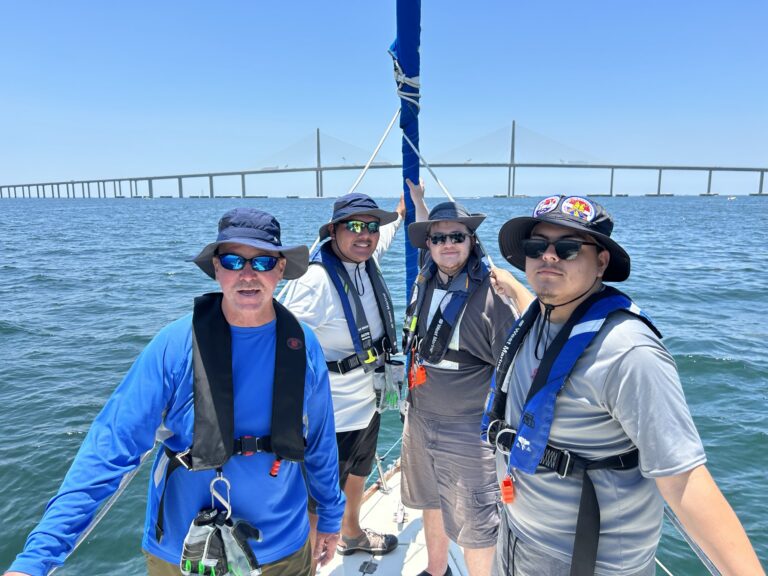
From sailing and boating to waterfront recreation and evening programs, Summer Port is packed with activities that make the most of the Loxahatchee River and the camp facilities.
Sailing
Spend time on the water and build your skills
Boating
Canoes, kayaks, and motorboats
Waterfront Recreation
Swimming, games, and open water time
Evening Programs
Campfires, games, and special events
DAILY SCHEDULE
A Full Week of Adventure
Each day at Summer Port is filled with classes, activities, and time with your ship and shipmates. While the exact schedule may vary, here’s what a typical day looks like.
Reveille & Morning Routine
Wake up, get ready for the day, and meet with your ship
Breakfast
Meals are served in the dining hall
Morning Classes
Attend your scheduled courses and skill-building sessions
Lunch
Recharge with a meal and time with your shipmates
Afternoon Activities
Sailing, boating, waterfront recreation, or additional classes
Dinner
Meals are served in the dining hall
Evening Program
Games, campfires, special events, and time with your ship
Taps/Lights Out
Time to rest up for another great day at Summer Port
